Publised on Nov 30, 2025
How to Build an Annual Budget for Your Business

Kisean Smith

An annual budget isn’t just a spreadsheet your accountant asks for.
It’s your financial game plan for the next 12 months.
A good budget helps you:
Plan revenue and expenses
See if your goals are realistic
Decide when to hire, invest, or cut costs
Avoid “surprise” cash crunches
Let’s walk through how to build a practical, business-focused annual budget—one that works whether you’re a solo operator or running a small team.
We’ll cover:
What an annual budget really is
The numbers you need before you start
How to project revenue by month
How to plan expenses (fixed, variable, and strategic)
How to factor in taxes, profit, and owner distributions without making them the star of the show
How to review and adjust your budget throughout the year
1. What an annual budget really is (for a business)
Think of your annual budget as:
A 12-month forecast of revenue, expenses, and profit that guides your decisions.
It’s not about guessing perfectly.
It’s about having a baseline plan so you can compare:
What you expected
vs.What actually happened
and then course-correct.
A strong business budget:
Aligns with your growth plans (new hires, locations, services)
Sets spending limits for key areas (marketing, payroll, tools)
Keeps leadership on the same page about priorities
2. Gather your financial “starting point”
Before you plan the future, get a clear picture of the past.
Pull the last 12 months (or as many as you have) of:
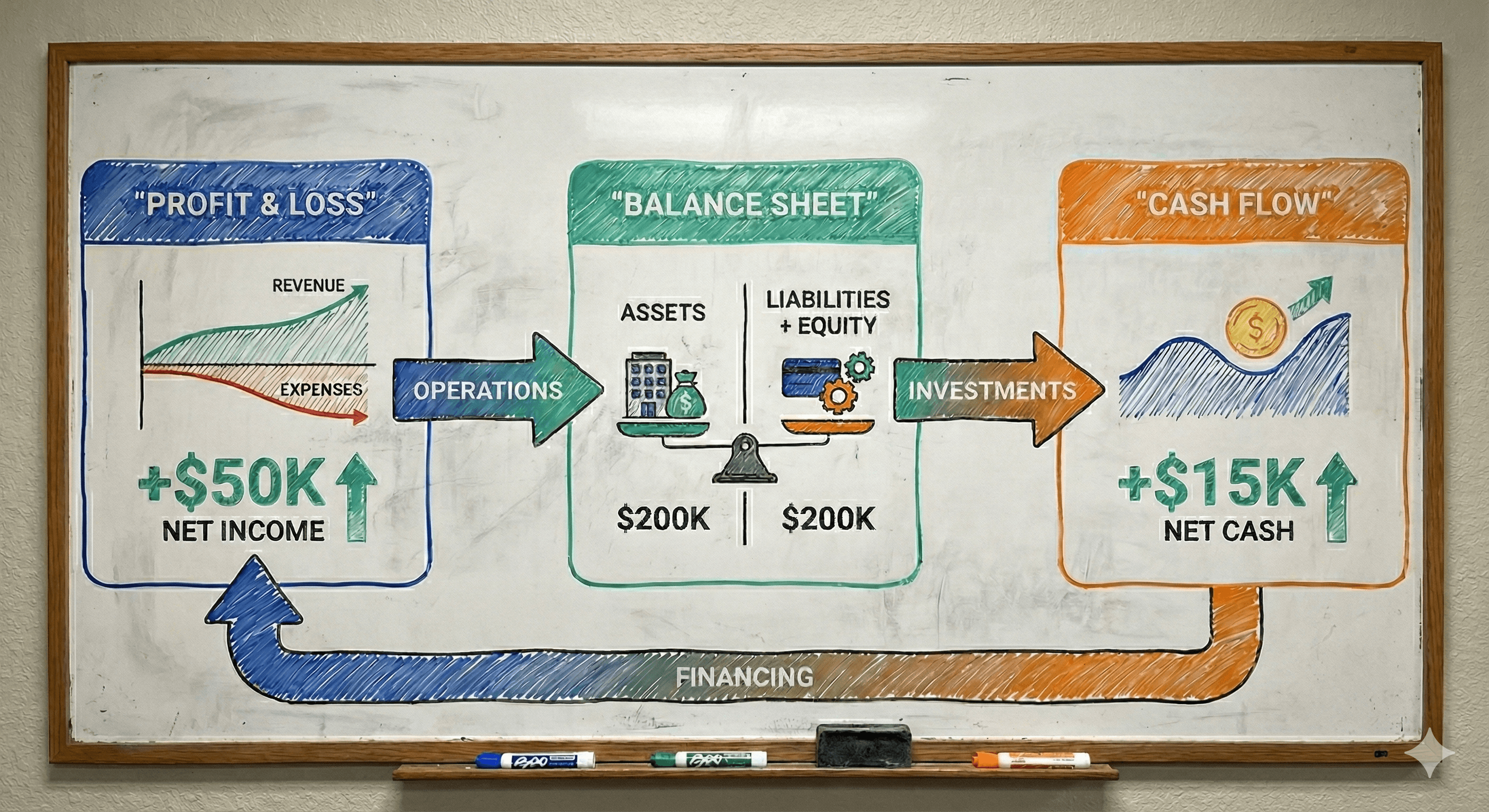
Profit & Loss (Income Statement)
Balance Sheet (for context on debt, assets, cash)
Bank and credit card statements
Any payroll or contractor reports
From this, calculate:
Total revenue for the year
Revenue by stream (services, products, retainers, etc.)
Major expense categories, such as:
Payroll & contractors
Rent / facilities
Software & subscriptions
Marketing & advertising
Operations (utilities, office supplies)
Professional services (legal, accounting)
You’re looking for patterns:
Seasonality (busy vs slow months)
Expenses that are increasing
Areas where spending doesn’t match results
This becomes the baseline for your new budget.
3. Map out revenue for the next 12 months
Start with how your business actually makes money.
Step 1: List your revenue streams
Examples:
Project-based services (e.g., consulting, design projects, build-outs)
Retainers or recurring contracts
Subscription or SaaS revenue
Product sales (physical or digital)
Training, workshops, or courses
Step 2: Estimate volume and pricing
For each stream, estimate by month or quarter:
Average price
Number of units (projects, clients, subscriptions, orders)
Example:
Revenue Stream | Price | Est. Qty / Month | Monthly Revenue |
|---|---|---|---|
Implementation projects | $8,000 | 3 | $24,000 |
Monthly service retainers | $1,200 | 10 | $12,000 |
Online course sales (average) | $200 | 15 | $3,000 |
Total | $39,000 |
Then, layer in seasonality:
Do Q2 and Q3 usually outperform Q1?
Are there predictable slow months (holidays, industry cycles)?
Your revenue plan should be ambitious but grounded in what has actually happened in your business.
4. Plan your expenses: fixed, variable, and strategic
Next, decide what it will cost to operate and grow your business.
Fixed expenses (baseline)
These don’t change much month to month:
Rent or office / coworking space
Software subscriptions
Insurance
Salaried payroll
Loan payments
Internet, phone
Use your past year as a guide and plug in monthly amounts across the year.
Variable expenses (scale with activity)
These go up and down with revenue or projects:
Contractor and hourly labor costs
Cost of goods sold (materials, printing, packaging)
Payment processing fees
Shipping
Usage-based software tools
Estimate these as:
A percentage of revenue, or
A per-unit cost tied to your revenue estimates
Strategic expenses (growth and improvement)
These are intentional investments to move the business forward:
Increased marketing or ad spend
Hiring or adding key roles
Training and development
New equipment or technology
Expansion costs (new location, new service line)
Build them into specific months where you expect to take action:
Example: “Increase ad spend by 50% starting in May”
or “Budget for new hire onboarding costs in Q3.”
This is where your budget becomes a strategy tool, not just a cost list.
5. Plan for taxes, profit, and owner distributions
The budget still needs to account for:
Taxes
Profit (money the business keeps)
Owner distributions (if applicable)
The key is to frame these as business requirements rather than personal goals.
Taxes
Work with your tax pro or use a safe estimate to:
Build in estimated income tax and payroll tax obligations
Decide on a target percentage of profit or revenue to set aside regularly
Add a line in your budget for “Estimated Tax Reserves” each month based on your projections.
This keeps taxes from becoming an ugly surprise.
Profit
Decide what level of profit the business should aim for, such as:
10–20% net profit margin as a general goal (varies by industry)
That means:
Profit = Revenue – All expenses (including payroll, including owners on payroll if applicable)
Your budget should be built so that:
You’re not spending every dollar that comes in
There is planned surplus to build reserves, reduce debt, or fund future investments
Owner distributions (briefly)
If you or other owners take distributions:
Add a planned distributions line to your budget (monthly or quarterly)
Treat it as one of the uses of profit, not the main driver of the budget
This keeps the focus where you want it:
on building a strong, healthy business that can support its owners sustainably.
6. Build a 12-month budget layout
Now you’re ready to put it all into a single view.
Create a spreadsheet (or use budgeting software) with:
Columns: January through December
Rows:
Revenue (broken out by stream)
Total Revenue
Direct Costs / Cost of Goods Sold
Gross Profit
Operating Expenses (grouped logically)
Strategic / one-time expenses
Estimated Taxes
Net Profit
Optional: Owner distributions and Ending Cash Projections
A simple structure might look like:
This layout lets you quickly see:
Which months are tight
When big costs hit
Whether your planned profit margin holds over the year
7. Stress-test your budget
Once your first version is built, test it:
Scenario 1: Revenue is 20% lower.
Can you still cover core expenses?
Do you need a plan for cutting discretionary spend?
Scenario 2: Costs are 10–15% higher.
What gets squeezed—profit, tax reserves, or planned investments?
Scenario 3: Growth exceeds expectations.
What will you need to invest in (staffing, tools, systems) to deliver well?
You don’t need dozens of scenarios—just enough to see how fragile or resilient your plan is.
8. Make your budget a monthly management tool
A budget only helps if you use it.
Set a simple monthly review rhythm:
Compare actuals vs budget for revenue and major expenses.
Note any big variances (positive or negative).
Decide whether to:
Adjust future months’ budget, or
Take corrective action (cut costs, delay a hire, increase marketing, etc.).
Quarterly, zoom out:
Are you on track with revenue, profit, and cash?
Do you need to shift strategy (pricing, offers, staffing) for the rest of the year?
Your budget should be a living document—updated as you learn more, not a rigid forecast you “failed” if reality doesn’t match.
9. When to bring in help with budgeting
Building an annual budget is especially valuable when:
You’re planning to hire, expand, or invest in new services
Your revenue is growing, but you can’t see where the money goes
Leadership needs a shared set of financial expectations for the year
You want to better manage cash flow, debt, and profitability
External support is useful when:
Your data is messy and you need help organizing it
You want someone to translate the numbers into clear decisions
You don’t want to manage a complex spreadsheet on your own
CTA: Let The Financial Smith help forge your annual business budget 🔨
At The Financial Smith, we specialize in turning scattered numbers into clear, practical annual budgets for businesses.
We help you:
Use your real financial data (even if it’s messy) as a starting point
Build a 12-month revenue and expense plan aligned with your business goals
Plan for taxes, profit, and cash reserves in a way that supports long-term stability
Stress-test your budget so you know how hiring, investments, or downturns would impact you
Walk away with a simple, understandable tool you can revisit each month
If you’d like a budget that does more than live in a spreadsheet:
👉 Book an annual budget planning session with The Financial Smith.
We’ll work with your numbers and your goals to forge a realistic, data-backed plan for the year—one you can actually use to run your business.